A theorist called Saussare stated that in everything there is a sign and signified. If Darkness and rain is the sign, then Saddness is signified.
Connotation - What can be suggested
Denotation - What might be seen
Wednesday, 9 February 2011

Feminism
Feminism is a representitive theory in which women believe that they should be treated equal to men. For example they believe they have the right to equal pay, equal rights etc. Feminists would see the media as disempowering women as they are hardly included as the lead protaginists in film and media productions, protagonist roles are usually assigned to men who carry the macho image that is required to fit into the mainstream.
The Theory
Academic feminist theory emerged as a response to the activism that became popular during the 1970's. Laura Mulvey's male gaze is often considered to be the most recognised and accurate theory that is put into practice. In film the male gaze consits of taking a viewpoint from a male's perspective in which a woman may be objectifed, for a example the camera may focus on the curves of a woman's body. Thus showing how women are often objectified and considered passive objects in both film and the broader media outputs.
The media is considered by feminists as being constructed for men. It is sometimes viewed as a Patriarchal society in which men command the power and women are subordinate, this is often portrayed for example in a police drama where men are in a position of power over women, such as being higher rank.
The Theory
Academic feminist theory emerged as a response to the activism that became popular during the 1970's. Laura Mulvey's male gaze is often considered to be the most recognised and accurate theory that is put into practice. In film the male gaze consits of taking a viewpoint from a male's perspective in which a woman may be objectifed, for a example the camera may focus on the curves of a woman's body. Thus showing how women are often objectified and considered passive objects in both film and the broader media outputs.
The media is considered by feminists as being constructed for men. It is sometimes viewed as a Patriarchal society in which men command the power and women are subordinate, this is often portrayed for example in a police drama where men are in a position of power over women, such as being higher rank.
Friday, 4 February 2011
Narcistic identification

This is an Image of a Rolling stones magazine with Led Zepplin on the cover.
Narcissistic identification demands identification with the object on the screen through the spectator's fascination with the recognition of his/her likeness.
Terminology
Masthead: Name of the magazine
Motto: Memorable phrase that is recognisable to a brand
Buzz Words: "Wow", "Exclusive", "Free" are all examples of this.
House Style: A magazine's distinctive design that distinguishes it from its competitors.
Puffs: Colourful boxes promoting features inside.
Strap Line: A slogan
Banner: Text which stands out on a coloured background generally at the bottom of the magazine.
Copy: The Main Story in the Magazine
Anchorage Text: The way in which text helps to pin down the meaning of a picture and vice versa.
Pugs: Placed at the top left and right corners of the paper and are known as the 'ears' of the page. The price of the paper, the logo or a promotion are often positioned there.
Headline: Catchy Title for the main article
Sell Lines: Text on the front cover that helps to sell the magazine to the audience
Caption: Description of the main image
Lead: The introductory paragraph of an article. Usually written in bold or capitals.
Drop Capitals: Really big letter that starts off an article
Motto: Memorable phrase that is recognisable to a brand
Buzz Words: "Wow", "Exclusive", "Free" are all examples of this.
House Style: A magazine's distinctive design that distinguishes it from its competitors.
Puffs: Colourful boxes promoting features inside.
Strap Line: A slogan
Banner: Text which stands out on a coloured background generally at the bottom of the magazine.
Copy: The Main Story in the Magazine
Anchorage Text: The way in which text helps to pin down the meaning of a picture and vice versa.
Pugs: Placed at the top left and right corners of the paper and are known as the 'ears' of the page. The price of the paper, the logo or a promotion are often positioned there.
Headline: Catchy Title for the main article
Sell Lines: Text on the front cover that helps to sell the magazine to the audience
Caption: Description of the main image
Lead: The introductory paragraph of an article. Usually written in bold or capitals.
Drop Capitals: Really big letter that starts off an article
Analysis of the same genre magazine

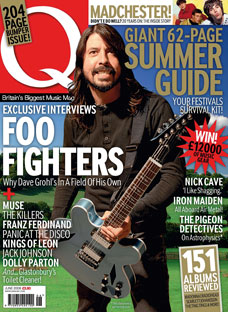
This blog entry is too show how the two magazine covers for Q have the same genre. The bands included in the magazines are greenday and Foo Fighters. therefore showing that the genre of the magazine is alternative rock. I will explain the hourstyle of the two magazines identifying the similarities and how the magazins are the same. The first thing that is similar between the magazines are that the image is overlapping the MastHead. this is the same for both magazines as it shows how the band is the selling the magazine as they are what the fans will want t read abut. The MastHead is the logo of Q magazine and it is placed in the tp right hand corner, another similarity. The semiotics of the magazine are also similar as the colours are red and white for the font colours. the backgrounds are both reasonably green and the font styles are also the same. with a use of large writing. The layout is also similar as unlike other music magazines such as kerrang the positioning is all fairly evenly spread whilst kerrang is very clusterd.
College Magazine Draft layout

This is my draft layout for my collage magazine that i have made on paint. This includes Masthead, Images, banner, Main Headline, and mottos
Thursday, 3 February 2011
Mood Board
 |
Subscribe to:
Posts (Atom)